
INNOVACION Y TECNOLOGIA PARA LA GESTION SANITARIA
miércoles, 22 de agosto de 2012


Coming Next: Using an App as Prescribed

Steve Ruark for The New York Times
Anand K. Iyer, president of WellDoc, which is marketing the DiabetesManager app.
By JOSHUA BRUSTEIN
Published: August 19, 2012
Before long, your doctor may be telling you to download two apps and call her in the morning.

Ozier Muhammad/The New York Times
Lee Perlman, left, and Benjamin Chodor of Happtique,
developer of a medical app that can facilitate the writing of
prescriptions.

Smartphone apps already fill the roles of television remotes, bike
speedometers and flashlights. Soon they may also act as medical devices,
helping patients monitor their heart rate or manage their diabetes, and
be paid for by insurance.
The idea of medically prescribed apps excites some people in the health
care industry, who see them as a starting point for even more
sophisticated applications that might otherwise never be built. But
first, a range of issues — around vetting, paying for and monitoring the
proper use of such apps — needs to be worked out.
“It is intuitive to people, the idea of a prescription,” said Lee H. Perlman, managing director of Happtique,
a subsidiary of the business arm of the Greater New York Hospital
Association. Happtique is creating a system to allow doctors to
prescribe apps, and Mr. Perlman suggested that a change in the way
people think about medicine might be required: “We’re basically saying
that pills can also be information, that pills can also be
connectivity.”
Simple apps that track users’ personal fitness goals have already gained
wide traction. Now medical professionals and entrepreneurs want to use
similar approaches to dealing with chronic ailments like diabetes or
heart disease.
If smartphone-based systems can reduce the amount of other medical care
that patients need, the potential benefit to the health care system
would be enormous; the total cost of treating diabetes alone in 2007 was $174 billion, according to the most recent statistics from the Centers for Disease Control and Prevention.
But unlike a 99-cent game, apps dealing directly with medical care
cannot be introduced to the public with bugs that will be fixed later.
The industry is still grappling with how to ensure quality and safety.
One of the pioneers in the prescription-app field is a company called WellDoc.
Its DiabetesManager system, which patients can use through a smartphone
app, standard cellphone or desktop computer, collects information about
a patient’s diet, blood sugar levels and medication regimen. Patients
can enter this data manually or link their devices wirelessly with
glucose monitors.
DiabetesManager then gives advice to a patient, perhaps suggesting the
best food after recording a low midday blood-sugar reading. It also uses
an algorithm to analyze the medical data and send clinical
recommendations to the doctor.
WellDoc says that in a clinical trial, DiabetesManager was shown to
reduce significantly the blood sugar levels in diabetes patients.
Those results persuaded the Food and Drug Administration to give the
system clearance to operate as a medical device. At over $100 a month,
the cost is more akin to diabetes drugs than to most smartphone apps.
But two insurance companies have already agreed to pay the bill for
patients whose doctors ask them to use the system when it is available
early next year, said Anand K. Iyer, the company’s president. He
declined to name the companies.
When Mr. Iyer began planning an app for WellDoc, he had something simple
in mind. But as the company pursued it he realized that it would have
to build something much more ambitious, in a process that ended up
taking years and millions of dollars in investment.
“As I learned more and more about the health care system, I realized
that the way to monetize this wasn’t as a 5-cent app in the app store,
but as a high-value system,” he said. “It wasn’t going to be a quick
ride.”
The app is one of fewer than 10 to date that has gained clearance from the F.D.A.
Sailesh Chutani, the co-founder of MobiSante,
which created a smartphone-based ultrasound system, said that his
company initially considered marketing it as a veterinary tool, or
selling it only overseas, to avoid an expensive vetting process. But the
company chose to ask to be regulated, in part because it made it easier
to attract investment. Last year the F.D.A. approved the system, which
includes an app and an ultrasound device that connects to the phone.
“Suddenly you’re sending a market signal that you have been vetted and
cleared by the toughest regulatory agency in the world,” Mr. Chutani
said.
It is still not completely clear how far regulation over medical apps
will extend. The F.D.A. plans to release guidelines later this year
outlining its approach to apps, while other agencies will be in charge
of privacy and data security.
Continua Health Alliance, an industry group, is also working on
standards so that medical apps collect data in compatible formats,
allowing patients to move their data from one app to another. There are
also questions of what happens when a prescribable app is available only
on certain types of phones.
At the same time, many apps being marketed as medical tools are being
designed to skirt federal regulation, in part by piling on the
disclaimers. Still, there is wide acknowledgment that many apps violate
current regulations by making dubious or untested medical claims. The
F.D.A. has shied away from going after such apps until its guidelines
are in place. The agency, which does not want to choke innovation, will
regulate only applications that act as medical devices by making
clinical or diagnostic decisions, said Bakul Patel, an F.D.A. policy
adviser.
Mr. Perlman of Happtique says he believes that doctors will soon
prescribe both clinically tested apps and more modest apps, like those
that track physical activity or remind patients to take their pills. The
company has established its own set of guidelines to determine the
quality of health care-related apps, and helps doctors integrate them
into their medical practice.
The company evaluates apps in several areas — diabetes, cardiology,
rheumatoid arthritis and physical therapy — and allows doctors to
prescribe apps to their patients from selected lists. It monitors
whether the patient has downloaded the app, and can send automated
reminders to those who have not done so. The company is opening its
system to doctors this week.
Skeptics, including John Moore, a physician at the M.I.T. Media Lab’s
new media medicine project, say that Happtique is ahead of its time,
since there are relatively few apps that are worth prescribing.
“Making a clearinghouse for apps today is a tough job because you’re
just filtering through a lot of stuff that doesn’t do much,” said Dr.
Moore. “But as a long-term vision, it’s an interesting idea.”
But the company says that it is setting up a framework so that it can
persuade insurance companies to pay for apps that doctors recommend. It
is also lobbying federal regulators to allow patients to use flexible
spending accounts to buy prescribed apps through its system.
“This is the transition from something that is superficial to serious
health care delivery,” Mr. Perlman said. “The health care system is
going to need somebody to help organize this.”
lunes, 20 de agosto de 2012
Una app avisa de una emergencia próxima a la ubicación del usuario
20/08/2012
JWT Singapore ha desarrollado una app que permite registrarse a
cualquier usuario y a profesionales de la salud, de forma que cuando
alguien tiene una emergencia, el usuario sólo que tiene que pulsar sobre
el icono de la aplicación y, mediante tecnología GPS, todos los
profesionales de la salud y el resto de usuarios registrados al sistema
que se encuentren cerca del lugar de la emergencia, recibirán un aviso
para poder atenderla.
Si quieres acceder a la aplicación, haz clic aquí.

Si quieres acceder a la aplicación, haz clic aquí.

FUENTE: redcross.org.sg

Tecnología y reflexión crítica
Las actuales herramientas tecnológicas mejoran la vida, pero pueden crear un pensamiento espasmódico y fragmentado

SI
no es fácil pensar el impacto que tiene el avance de la tecnología en
la vida contemporánea es porque carecemos de perspectiva para pensar los
fenómenos en tiempo real, es decir, en el momento mismo en que están
ocurriendo.
Podría afirmarse, sin embargo, que como Jano, el
mitológico dios romano de dos caras, el impacto que genera la tecnología
en la vida contemporánea tiene aspectos positivos y negativos, y trae
mejoras inmensas para la vida de las personas, así como riesgos
potenciales, que no deben ser olvidados. Una actitud equilibrada frente a
la tecnología supone apreciar lo que nos ofrece y estimular su avance, a
la vez que permanecer alertas frente a sus efectos indeseados.La tecnología ha mejorado nuestra vida en casi todos los órdenes, en particular en la medicina, en el comercio, en la industria, así como en numerosos campos de la actividad humana.
En forma complementaria, hay que recordar, como señala el pensador francés Paul Virilio, que inventar un objeto técnico significa inventar su propio accidente. El tren inventa la catástrofe ferroviaria, la electricidad da lugar a la electrocución, la energía atómica produce la bomba atómica.
Desde esta óptica, pueden analizarse algunas de las tecnologías que dominan la escena contemporánea, como es el caso, por ejemplo, de Internet y de las redes sociales. En efecto, éstas han permitido extender hasta límites inimaginables la capacidad para ponerse en contacto con los demás, han facilitado la vida de relación, y han permitido, como en el caso de Facebook, conectarse con gente a la distancia de una manera nunca vista antes.
También han permitido participar de espacios de afinidad, compartir intereses y definir grupos de pertenencia. En el caso de Twitter, a su vez, nos mantiene también conectados con gente a la que no tendríamos acceso de otro modo, nos permite generar nuevos vínculos e interactuar con la comunidad, independientemente del lugar en el que estemos. Esta herramienta ha posibilitado, a la vez, a los pueblos defenderse de los regímenes autoritarios y organizar su resistencia de manera efectiva.
Pero lo que hay que tener en cuenta es que la tecnología, más allá de ser un extraordinario instrumento, tiene también el poder de modelar subrepticiamente al hombre que la usa. En efecto, también estas tecnologías están comenzando a afectar la manera como pensamos. Y con ello puede estar cambiando de a poco la forma de ser del hombre frente al mundo.
La generación que ha crecido en estado de inmersión en Internet muestra, como efecto indeseado, un pensamiento de tipo espasmódico y una atención excesivamente fragmentada, que va minando la capacidad de las personas y, en particular, de los jóvenes, para concentrarse en una actividad que requiera un esfuerzo sostenido, sea una lectura larga o un análisis profundo de un texto. Porque aquellos formatos tecnológicos generan un acostumbramiento del cerebro a ser nutrido por pequeños fragmentos de comunicación y por el estilo multitarea, cosa que, adicionalmente, puede tornarse adictiva. Y las redes pueden convertirse en grandes consumidores del tiempo de los más jóvenes.
En la época que nos toca vivir es necesario no confundir la conectividad con la compañía, ya que nada reemplaza los vínculos directos con las personas. Y es necesario mantener la lucidez que nos permita siempre distinguir la información del conocimiento, y a su vez, el conocimiento de la sabiduría.
No sólo en los casos mencionados, sino en general el impacto de la tecnología es paradojal. Depende del uso que le demos, aprovecharemos todo lo bueno que trae, minimizando sus riesgos. Para ello es necesario mantener alerta el pensamiento, que es lo que tiende a permanecer rezagado frente al avance técnico, para que la tecnología siga siendo una herramienta de la cual nos sirvamos, y que no se convierta imperceptiblemente en una forma de deshumanización.
No es cuestión de mostrarse acríticamente favorables a la tecnología ni tampoco de convertirnos en críticos infundados de ella. Es necesario incorporar lo que nos traen los nuevos tiempos, acompañados siempre de una reflexión crítica..
Undergraduates’ Cellphone Screening Device for Anemia Wins $250,000 Prize
July 24, 2012
Media Contact: Phil Sneiderman
Office: (443) 287-9960; Cell: 410-299-7462
prs@jhu.edu
Could a low-cost screening device connected to a cellphone save
thousands of women and children from anemia-related deaths and
disabilities?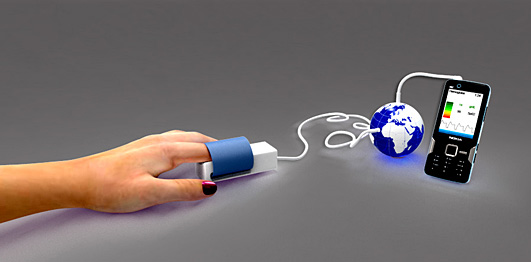
This conceptual image illustrates how the HemoGlobe anemia screening device would connect with a health worker’s cellphone.
The device’s sensor, placed on a patient’s fingertip, shines different wavelengths of light through the skin to measure the hemoglobin level in the blood. On their phone’s screen, community health workers will quickly see a color-coded test result, indicating cases of anemia, from mild to moderate and severe.
If anemia is detected, women would be encouraged to follow a course of treatment, ranging from taking iron supplements to visiting a clinic or hospital for potentially lifesaving measures. After each test, the phone would send an automated text message with a summary of the results to a central server, which would produce a real-time map showing where anemia is prevalent. This information could facilitate follow-up care and help health officials to allocate resources where the need is most urgent.
Soumyadipta Acharya, an assistant research professor in Johns Hopkins’ Department of Biomedical Engineering and the project’s faculty advisor and principal investigator, said the device could be an important step in reducing anemia-related deaths in developing countries. International health experts estimate that anemia contributes to 100,000 maternal deaths and 600,000 newborn deaths annually.
“This device has the potential to be a game-changer,” Acharya said. “It will equip millions of health care workers across the globe to quickly and safely detect and report this debilitating condition in pregnant women and newborns.”
The HemoGlobe student inventors have estimated their cellphone-based systems could be produced for $10 to $20 each.
At the recent Saving Lives at Birth: A Grand Challenge for Development competition, the potential public health benefits of this device won over the judges, who awarded a $250,000 seed grant to the Johns Hopkins students’ project. The event, which attracted more than 500 entrants from 60 countries, was sponsored by prominent global health organizations, including the U.S. Agency for International Development and the Bill & Melinda Gates Foundation. Only 12 entrants received seed grants.
“When we thought about the big-name corporations and nonprofit groups we were competing against, we were amazed and surprised to find out that our team had won,” said George Chen, 19, of Hacienda Heights, Calif., a sophomore majoring in biomedical engineering. Chen attended the July 14 announcement ceremony in Seattle, along with Acharya and team members Noah Greenbaum and Justin Rubin.
For a biomedical engineering design team class assignment, a group of students spent a year brainstorming and building a prototype. The seed grant will allow the team to refine their technology, as well as support field testing next year in Kenya by Jhpiego, a Johns Hopkins affiliate that provides global health training and services for women and their families. Jhpiego sponsored the HemoGlobe project through a partnership with the university’s Center for Bioengineering Innovation and Design.
Team member Greenbaum, 21, of Watchung, N.J, a senior majoring in biomedical and electrical engineering, has continued working on the anemia system this summer. “The first year we just focused on proving that the technology worked,” he said. “Now, we have a greater challenge: to prove that it can have a real impact by detecting anemia and making sure the mothers get the care they need.”
The student inventors were looking for a new way to curb a stubborn health problem in developing nations. Anemia occurs when a person has too few healthy red blood cells, which carry critical oxygen throughout the body. This is often due to a lack of iron, and therefore a lack of hemoglobin, the iron-based protein that helps red blood cells store and release oxygen. Anemic mothers face many complications before and during birth, including death from blood loss associated with the delivery. In addition, a baby that survives a birth from an anemic mother may face serious health problems.
Health officials in developing countries have tried to respond by making iron supplements widely available. But, according to Acharya, the problem of anemia remains intractable. “So we looked at it from a different angle,” he said.
In places where medical care is easily accessible, doctors routinely test pregnant women for anemia and prescribe treatment, including routine iron supplementation. But in developing regions where medical help is not always nearby, the condition may go undetected. However, community health workers with limited training do serve these areas.
“The team members realized that every community health worker already carries a powerful computer in their pocket—their cellphone,” Acharya said. “So we didn’t have to build a computer for our screening device, and we didn’t have to build a display. Our low-cost device will use the existing cellphones of health workers to estimate and report hemoglobin levels.”
A provisional patent covering the invention has been obtained through the Johns Hopkins Technology Transfer office.
In addition to Chen, Greenbaum and Rubin, other Whiting School of Engineering students who have participated on the team are Guilherme Barros, William Chen, Judy Doong, Phillip Oh and David Yin.
Color graphics of the invention are available; contact Phil Sneiderman.
Related links:Johns Hopkins Department of Biomedical Engineering: http://www.bme.jhu.edu/
Center for Bioengineering Innovation & Design: http://cbid.bme.jhu.edu/
Jhpiego: http://www.jhpiego.org/
Whiting School of Engineering: http://engineering.jhu.edu/
###
Johns Hopkins University news releases can be found on the World Wide Web at http://www.jhu.edu/news_info/news/ Information on automatic E-mail delivery of science and medical news releases is available at the same address.
Office of Communications
Johns Hopkins University
901 South Bond Street, Suite 540
Baltimore, Maryland 21231
Phone: 443-287-9960 | Fax: 443-287-9920
viernes, 17 de agosto de 2012
Docphin is your medical library journals all in one app
 App Reviewed: Docphin (Ver. 1.0)
Goals of Review:
- Review Docphin’s platform for use among health professionals as a way to manage medical literature and media
- Assess Docphin’s new app for ability to provide easily accessible medical literature
What is Docphin?
I would like to introduce today a new platform on the computer and at the palm of your hands to help keep abreast with medical news and research.Founded by a group of physicians in 2010, Docphin (Docphin – the Personalized Health Information Network) seeks to address the need of medical professionals to keep up-to-date on the medical literature in a easily accessible form. In essence, Dophin is a platform that is integrated with a Hospital/Institution’s library.
What this means, is that instead of utilizing a browser to search the online library for articles and papers, Docphin serves as an integrated portal to help access those papers for you, without utilizing a web browser or going through different logins or journal portals.
This cuts down time and speeds up access to the medical literature.
How does it work?
Docphin’s website allows a user to register for free and create a profile, provided they are a member of one of the current institutions working with Docphin. If you cannot find your institution is a collaborator yet, you can request Docphin to reach out and invite the institution to join.Currently, Docphin has greatly expanded and is enrolling multiple institutions in its short time of operation. This can be followed closely with their blog.

After registering with Docphin, the user may then customize the website to fit their needs. This includes selecting pertinent medical journals and news media sources that the user would like to primarily concentrate on. Options are broken down into different medical specialties (e.g. general medicine, cardiology) with associated medical journals. Twitter also is integrated with Docphin to allow a stream of updates on a certain area of interest to be viewed, which is also broken down by specialties.

Users may then look for articles or read papers of interest. Choosing an article will then bring it up from the library that the user is associated with. This can then be read or downloaded as a PDF. Articles can also then be favorited and stored on the user’s profile. In order to help manage their collection, users can create and tag articles for their own searches in the future.
For example, if I am looking through my collection of papers for something dealing with sports medicine, I can look for all articles that I had tagged with ‘sports’ or ‘sports medicine.’


Suscribirse a:
Entradas (Atom)